
Australian Property Market Update: Why Homes Are Taking Two Weeks Longer to Sell Since the Budget
By Atom Go Tian, Economist at Ray White
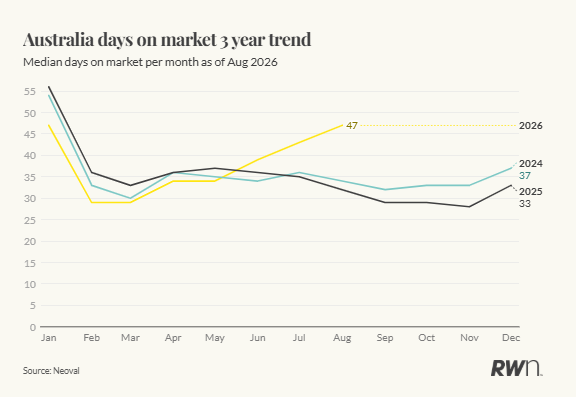
For three consecutive years, the average time required to sell a home across Australia remained remarkably stable—regardless of macroeconomic shifts, rising interest rates, or inflation spikes. However, following recent Federal Budget announcements, national real estate data indicates a significant shift in market velocity.
Between May and August, the national median Days on Market (DOM) jumped from 34 days to 47 days, adding nearly two full weeks to the selling timeline for Australian property vendors.
What Is Driving the Increase in Days on Market?
Prior to May, property listings typically spent between 29 and 37 days on the market before securing a buyer (excluding the standard seasonal slowdown in January). Even when inflation figures came in higher than expected earlier in the year and interest rates adjusted accordingly, buyer demand continued to absorb new listings quickly.
The recent post-Budget slowdown is largely driven by prospective buyers and property investors taking a cautious pause to digest announced policy changes, particularly regarding:
-
Proposed Restrictions to Negative Gearing
-
Modifications to Capital Gains Tax (CGT) Models
-
Ongoing Inflation Pressures and Interest Rate Expectations
While these tax policy adjustments do not officially take effect until June 2027, buyer sentiment has reacted immediately. As a result, new listings are entering the market faster than buyers are stepping up to purchase them.
City-by-City Breakdown: Which Real Estate Markets Are Slowing Down Most?
The national slowdown is not occurring evenly across every state and region. Markets that experienced the explosive growth during the recent property cycle are currently seeing the largest increases in total selling time.
-
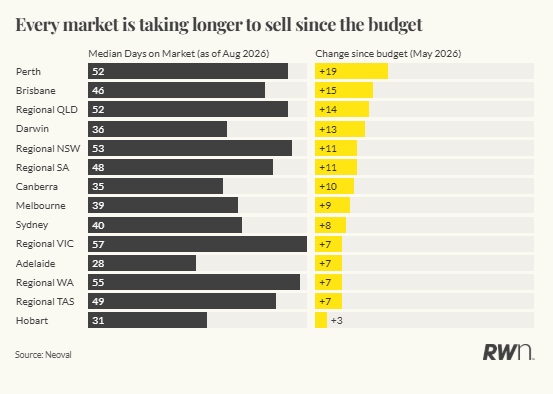
Perth & Brisbane: Experiencing the largest shift nationwide. Perth’s median Days on Market surged by 19 days (from 31 to 52 days), while Brisbane jumped by 15 days (from 31 to 46 days). Sales volume in both capitals dropped by over 6% over the quarter, even as new listing stock grew by 1.5%.
-
Regional Queensland & Regional NSW: Regional Queensland saw an increase of 14 days (rising to 52 days), while Regional NSW increased by 11 days (rising to 53 days).
-
Sydney & Melbourne: Demand cooled in Sydney and Melbourne, but sellers in these major capitals reacted by pulling back listing supply proportionally, keeping market balance tighter. Sydney’s median DOM rose by 8 days (to 40 days) and Melbourne by 9 days (to 39 days).
-
Adelaide & Hobart: Adelaide remains the fastest capital city market in Australia, averaging just 28 days to sell despite a 7-day increase. Hobart saw the smallest shift, adding just 3 days (rising to 31 days) as listing volumes dropped by 4.9%.
Original Article: https://www.raywhite.com/news-and-market-insights/economic-updates/since-the-budget-homes-are-taking-two-weeks-longer-to-sell

Luke O’Kelly is a real estate agent and auction specialist at Ray White West End, focused on property sales in West End and Highgate Hill. Through Luke O’Kelly Ray White West End, he helps property owners achieve strong results using an auction-led strategy designed to create competition and maximise sale prices. With deep local market knowledge and a hands-on approach, Luke shares insights, sales strategies and suburb updates to help sellers make informed decisions and achieve the best possible outcome.